For over four decades, Cabnave has been a reference in ship repair in the Atlantic, combining tradition, safety and quality....
Dry-docking is essential for any intervention on the ship’s hull below the waterline. Only with the vessel out of the water can the following be carried out:
– Comprehensive structural inspection of the hull
– Assessment of submerged damage
– Application of antifouling systems
– Mechanical and structural repairs
– Welding work and plate replacement
The safety of this operation depends on rigorous calculations, prior planning, and continuous monitoring.
Even before the ship arrives at the shipyard, technical preparation begins.
Based on the vessel’s structural plans (cavername), the following are defined:
– Number of trolleys required
– Arrangement of beams
– Height of supports
– Structural support points
– Marking of scuppers, probes, and drains
This planning ensures adequate load distribution and prevents constraints during technical interventions.
Before each manoeuvre, the technical team conducts a preventive inspection, including:
– Checking the hauling winches
– Inspecting beam drains
– Cleaning and lubricating critical shafts
– Verifying cable limits
– Checking the side guides
These procedures reduce mechanical risks and ensure correct alignment during the operation.
The platform is powered by an electromechanical system composed of:
– Alternating current motor (converter motor)
– AC-DC converter group
– Main motor
– Gearbox
– Shaft system
– Eight main traction winches
The converter group transforms alternating current into direct current to supply the main motor, which drives the winches responsible for raising the platform along the inclined plane.
During the manoeuvre, the control tower continuously monitors:
– Excitation current
– Motor temperature
– Pressure and stability indicators
This monitoring ensures that the ship’s weight does not exceed the infrastructure’s maximum capacity.
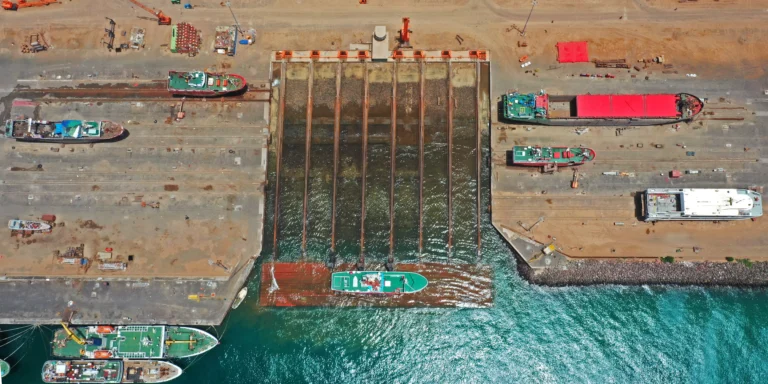
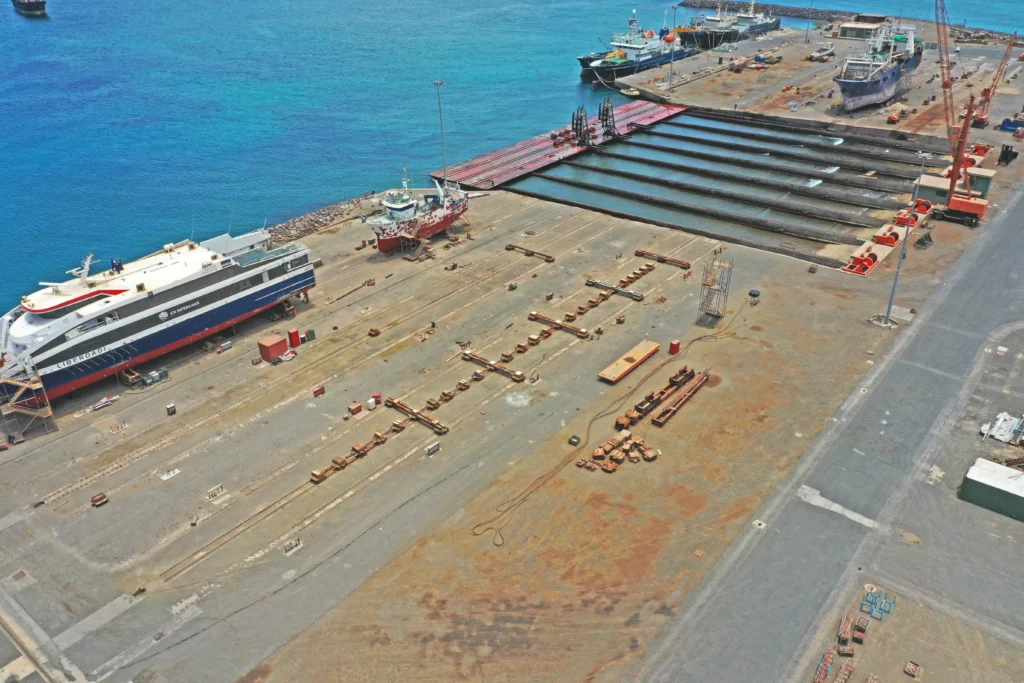
With the berth correctly positioned and secured, the platform is submerged to approximately 5.5 metres (depending on the tide).
A minimum difference between the submersion depth and the ship’s draught is required. This clearance is essential to avoid impacts on the hull or berth.
Once the vessel is correctly positioned, hauling begins – gradually lifting the ship out of the water.
With the platform now emerged, alignment with the hauling yard follows. The platform’s longitudinal rails must coincide with those of the yard, ensuring a smooth and safe transition.
Once the manoeuvre is completed, operators follow a sequential procedure:
– Controlled shutdown of systems
– Wait for complete cessation of motor ventilation
– Return of energy to the substation
– Reactivation of the heating system
This protocol preserves equipment durability and ensures readiness for future operations.
Cabnave’s hauling platform is a cornerstone that underpins the company’s ability to provide naval repair services with high standards of safety and efficiency.
The combination of:
– Robust infrastructure
– Rigorous technical procedures
– Continuous monitoring
– A specialised team
enables reliable solutions for vessels operating in the mid-Atlantic region.
If you wish to carry out structural inspections, hull maintenance, or technical repairs, Cabnave has the infrastructure and expertise required to ensure a safe and efficient operation.
Get in touch with our technical team for the assessment and planning of your next dry-docking.

For over four decades, Cabnave has been a reference in ship repair in the Atlantic, combining tradition, safety and quality....

Efficiency in shipyards depends not only on technical expertise but also on how teams are managed. Strategic management ensures that...

The world of the naval industry can seem complex to those taking their first steps in this sector. In this...
A ship's longevity and performance are directly linked to the quality of the technical inspections carried out throughout its life...
Share with industry professionals: